Wednesday, April 25, 2012
A loss For Words
Hello friends! I’m Lauren from techno-lolo.blogspot.com guest blogging for Roman. Enjoy!
“Your world. Delivered.”
“Built for the road ahead.”
“What’s in your wallet?”
“Because I’m worth it.”
You may not realize it, but all of the above are slogans from companies whose products you may be using right now. In fact, companies spend billions of dollars per year on advertising and use slogans to attract and gain the attention of consumers. According to Robert Jones from brand experts Wolff Olins, “If it somehow expresses the big idea of an organization, a slogan can be very useful. If it doesn't, consumers will see through it and discard it." This BBC News article from 2006 describes slogans as establishing a framework for the company’s values and customers expect them to live up to their standards.
This can help or hurt the corporation, but Peter Saville, creative director of the city of Manchester, has a different take on slogans. He sees slogans as a “sign of insecurity” and that “If your place needs a slogan, it has a problem. A brand is not just a logotype, it's a set of values that are communicated through actions.” Saville sees modern corporations putting less emphasis on word and more emphasis on deed and I’d have to agree with him.
Advertisements are becoming less about shoving slogans down our throats and more about showing how awesome a product or service is. Corporations are just getting less wordy and more showy.


Sunday, April 15, 2012
The Little Prince
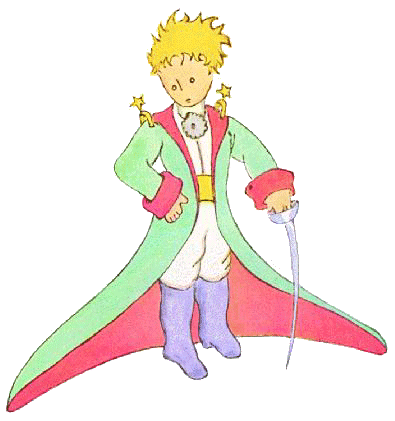
There is also an online version of the book in English for those who want to read it.
As with any translation, different languages use different constructions and sometimes non-literal translations of words to convey the same essential meaning. Most often however, the differences in word choice are distinct enough for interpretation to vary. In chapter 8 for example, the Little Prince's rose asks him for a screen to shield her from the wind.
In English: "The screen?"
"I was just going to look for it when you spoke to me..."In French: "Ce paravent?..."
"J'allais le chercher mais vous me parliez!"
There is a clear difference in tone. The English version paints a picture of an agitated rose, and an awkwardly apologetic prince. The French version has these roles flipped. This is evident with the punctuation. The ... at the end of a phrase shows that the speaker has not physically said all the want to say, there is a certain lack of closure to the speaker's thoughts. Often it shows that the speaker is uncomfortable. In the English version, the prince appears off-guard, and even slightly defensive because of the ... . The same sentence without reads "I was just going to look for it when you spoke to me.". This has a much more definitive tone, more so as if stating a fact. The ... makes the prince seem apologetic.
The French rose's ... has a very similar effect, it shows her discomfort at lack of a screen. Here however, the prince's response is much more agitated. There is even an exclamation point, which moves the tone from simply fact-stating to a more emotional outburst. The french version also uses the word but (in french: mais) to replace the English "when". If translated directly, the English version would have said "I was looking for it but you spoke to me!" This sentence does a better job of conveying the prince's disdain for the rose's vanity, which makes for a stronger case for him leaving her in the next chapter.
It is the details that make all the difference. The seemingly irrelevant details that readers rarely consciously notice have a profound effect on interpretation.
Tuesday, April 3, 2012
Values
I took part recently in an activity designed to quantify my values. I was presented with a list of 20 items, and a hypothetical $100,000 to distribute among each cause however I would like. Each item applies personally to you unless otherwise noted. The list is as follows:
1. An en to hunger world wide
2. a happy mariage
3. a long life of physical health
4. Peace between the US and all other countries
5. The reversal of global warming
6. Fame
7. An end to capital punishment
8. A good education
9. The ability to choose the POTUS* for the rest of your life
10. An end to racism
11. Enough money so that you wouldn't have to work for the rest of your life
12. Outsanding musical/artistic talent
13. An end to abortion
14. Equal rights for women world-wide
15. Legalization of gay marriage
16. Outstanding athletic talen
17. Spiritual enlightenment
18. World-wide democracy
19. Nuclear disarmement
20. World-wide acceess to effecive contraception
*President of the United States
Needless to say, the phrasing matters. There are for example many reduncacies, depnding on your goals of course. Personally, I see no need for "Outstanding" athletic talent if I can live a long life of good health. That is one of those areas where I am fully content with just being good but not great. World wide access to contraception may null the need for an end to hunger, as it would do a great deal to alleviate hunger in the first place, with less children being born. Then again, an end to world hunger might entail better contraception in the first place, it could be argued as more direct.
There is also some ambiguity. Equal rights for women world-wide. Does that mean that all women are equal to all other women, or that they are all equal to men? or Fame. Does that mean celebrity Paris Hilton type fame, or recognition for one's accomplishments? Or Peace between the US and all other countries. Does this mean that the US has no more quarrells, but other countries can fight amongst themselves? Or simply, world peace? The US-centric approach to the statement puts to question the benefit of the result, as it potentially only benefits Americans.
Some things are worded rather definitevely. An end to abortion implies not that abortions would be illegal necessarily, but just that nobody would have them anymore. For the sake of determining one's value, this is actually better, as here there is less ambiguity about how many people would still be having abortions, illegal or not.
It's a very interesting excercise, and I reccomend you try it. The wording of each item makes a huge impact on the reasoning taken to justify whatever amount of money alloted to each cause. An interesting experiment to conduct would be to reword each item in a different list, and see if people respond any differently to the second one. I hypothesize that they would.
1. An en to hunger world wide
2. a happy mariage
3. a long life of physical health
4. Peace between the US and all other countries
5. The reversal of global warming
6. Fame
7. An end to capital punishment
8. A good education
9. The ability to choose the POTUS* for the rest of your life
10. An end to racism
11. Enough money so that you wouldn't have to work for the rest of your life
12. Outsanding musical/artistic talent
13. An end to abortion
14. Equal rights for women world-wide
15. Legalization of gay marriage
16. Outstanding athletic talen
17. Spiritual enlightenment
18. World-wide democracy
19. Nuclear disarmement
20. World-wide acceess to effecive contraception
*President of the United States
Needless to say, the phrasing matters. There are for example many reduncacies, depnding on your goals of course. Personally, I see no need for "Outstanding" athletic talent if I can live a long life of good health. That is one of those areas where I am fully content with just being good but not great. World wide access to contraception may null the need for an end to hunger, as it would do a great deal to alleviate hunger in the first place, with less children being born. Then again, an end to world hunger might entail better contraception in the first place, it could be argued as more direct.
There is also some ambiguity. Equal rights for women world-wide. Does that mean that all women are equal to all other women, or that they are all equal to men? or Fame. Does that mean celebrity Paris Hilton type fame, or recognition for one's accomplishments? Or Peace between the US and all other countries. Does this mean that the US has no more quarrells, but other countries can fight amongst themselves? Or simply, world peace? The US-centric approach to the statement puts to question the benefit of the result, as it potentially only benefits Americans.
Some things are worded rather definitevely. An end to abortion implies not that abortions would be illegal necessarily, but just that nobody would have them anymore. For the sake of determining one's value, this is actually better, as here there is less ambiguity about how many people would still be having abortions, illegal or not.
It's a very interesting excercise, and I reccomend you try it. The wording of each item makes a huge impact on the reasoning taken to justify whatever amount of money alloted to each cause. An interesting experiment to conduct would be to reword each item in a different list, and see if people respond any differently to the second one. I hypothesize that they would.
Subscribe to:
Posts (Atom)