With the school year coming to a close, so is this blog. As a goodbye, I would like to recapitulate what this blog stood for.
This was a tribute to the power and versatility of language. Words after all, represent feelings and ideas that are felt by the speaker, and combinations of these words almost magically manage to convey volumes of information.
In fact, in speaking we convey even more information than we might like. For example when lying, many people tend to decrease the usage of the word "I", in trying to draw attention from themselves. Not that I'm calling all of you out there liars or anything, but an understanding of the more hidden meanings and connotations that language contains leads to better communication. Humans being inherently social creatures, communication is of course vital.
Hopefully after the past year I've managed to convince you of the power of language. After all, the pen is mightier than the sword.
Take Care,
Roman.
Monday, May 28, 2012


Wednesday, April 25, 2012
A loss For Words
Hello friends! I’m Lauren from techno-lolo.blogspot.com guest blogging for Roman. Enjoy!
“Your world. Delivered.”
“Built for the road ahead.”
“What’s in your wallet?”
“Because I’m worth it.”
You may not realize it, but all of the above are slogans from companies whose products you may be using right now. In fact, companies spend billions of dollars per year on advertising and use slogans to attract and gain the attention of consumers. According to Robert Jones from brand experts Wolff Olins, “If it somehow expresses the big idea of an organization, a slogan can be very useful. If it doesn't, consumers will see through it and discard it." This BBC News article from 2006 describes slogans as establishing a framework for the company’s values and customers expect them to live up to their standards.
This can help or hurt the corporation, but Peter Saville, creative director of the city of Manchester, has a different take on slogans. He sees slogans as a “sign of insecurity” and that “If your place needs a slogan, it has a problem. A brand is not just a logotype, it's a set of values that are communicated through actions.” Saville sees modern corporations putting less emphasis on word and more emphasis on deed and I’d have to agree with him.
Advertisements are becoming less about shoving slogans down our throats and more about showing how awesome a product or service is. Corporations are just getting less wordy and more showy.
Sunday, April 15, 2012
The Little Prince
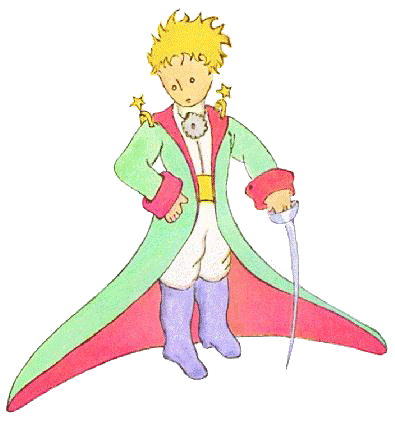
There is also an online version of the book in English for those who want to read it.
As with any translation, different languages use different constructions and sometimes non-literal translations of words to convey the same essential meaning. Most often however, the differences in word choice are distinct enough for interpretation to vary. In chapter 8 for example, the Little Prince's rose asks him for a screen to shield her from the wind.
In English: "The screen?"
"I was just going to look for it when you spoke to me..."In French: "Ce paravent?..."
"J'allais le chercher mais vous me parliez!"
There is a clear difference in tone. The English version paints a picture of an agitated rose, and an awkwardly apologetic prince. The French version has these roles flipped. This is evident with the punctuation. The ... at the end of a phrase shows that the speaker has not physically said all the want to say, there is a certain lack of closure to the speaker's thoughts. Often it shows that the speaker is uncomfortable. In the English version, the prince appears off-guard, and even slightly defensive because of the ... . The same sentence without reads "I was just going to look for it when you spoke to me.". This has a much more definitive tone, more so as if stating a fact. The ... makes the prince seem apologetic.
The French rose's ... has a very similar effect, it shows her discomfort at lack of a screen. Here however, the prince's response is much more agitated. There is even an exclamation point, which moves the tone from simply fact-stating to a more emotional outburst. The french version also uses the word but (in french: mais) to replace the English "when". If translated directly, the English version would have said "I was looking for it but you spoke to me!" This sentence does a better job of conveying the prince's disdain for the rose's vanity, which makes for a stronger case for him leaving her in the next chapter.
It is the details that make all the difference. The seemingly irrelevant details that readers rarely consciously notice have a profound effect on interpretation.
Tuesday, April 3, 2012
Values
I took part recently in an activity designed to quantify my values. I was presented with a list of 20 items, and a hypothetical $100,000 to distribute among each cause however I would like. Each item applies personally to you unless otherwise noted. The list is as follows:
1. An en to hunger world wide
2. a happy mariage
3. a long life of physical health
4. Peace between the US and all other countries
5. The reversal of global warming
6. Fame
7. An end to capital punishment
8. A good education
9. The ability to choose the POTUS* for the rest of your life
10. An end to racism
11. Enough money so that you wouldn't have to work for the rest of your life
12. Outsanding musical/artistic talent
13. An end to abortion
14. Equal rights for women world-wide
15. Legalization of gay marriage
16. Outstanding athletic talen
17. Spiritual enlightenment
18. World-wide democracy
19. Nuclear disarmement
20. World-wide acceess to effecive contraception
*President of the United States
Needless to say, the phrasing matters. There are for example many reduncacies, depnding on your goals of course. Personally, I see no need for "Outstanding" athletic talent if I can live a long life of good health. That is one of those areas where I am fully content with just being good but not great. World wide access to contraception may null the need for an end to hunger, as it would do a great deal to alleviate hunger in the first place, with less children being born. Then again, an end to world hunger might entail better contraception in the first place, it could be argued as more direct.
There is also some ambiguity. Equal rights for women world-wide. Does that mean that all women are equal to all other women, or that they are all equal to men? or Fame. Does that mean celebrity Paris Hilton type fame, or recognition for one's accomplishments? Or Peace between the US and all other countries. Does this mean that the US has no more quarrells, but other countries can fight amongst themselves? Or simply, world peace? The US-centric approach to the statement puts to question the benefit of the result, as it potentially only benefits Americans.
Some things are worded rather definitevely. An end to abortion implies not that abortions would be illegal necessarily, but just that nobody would have them anymore. For the sake of determining one's value, this is actually better, as here there is less ambiguity about how many people would still be having abortions, illegal or not.
It's a very interesting excercise, and I reccomend you try it. The wording of each item makes a huge impact on the reasoning taken to justify whatever amount of money alloted to each cause. An interesting experiment to conduct would be to reword each item in a different list, and see if people respond any differently to the second one. I hypothesize that they would.
1. An en to hunger world wide
2. a happy mariage
3. a long life of physical health
4. Peace between the US and all other countries
5. The reversal of global warming
6. Fame
7. An end to capital punishment
8. A good education
9. The ability to choose the POTUS* for the rest of your life
10. An end to racism
11. Enough money so that you wouldn't have to work for the rest of your life
12. Outsanding musical/artistic talent
13. An end to abortion
14. Equal rights for women world-wide
15. Legalization of gay marriage
16. Outstanding athletic talen
17. Spiritual enlightenment
18. World-wide democracy
19. Nuclear disarmement
20. World-wide acceess to effecive contraception
*President of the United States
Needless to say, the phrasing matters. There are for example many reduncacies, depnding on your goals of course. Personally, I see no need for "Outstanding" athletic talent if I can live a long life of good health. That is one of those areas where I am fully content with just being good but not great. World wide access to contraception may null the need for an end to hunger, as it would do a great deal to alleviate hunger in the first place, with less children being born. Then again, an end to world hunger might entail better contraception in the first place, it could be argued as more direct.
There is also some ambiguity. Equal rights for women world-wide. Does that mean that all women are equal to all other women, or that they are all equal to men? or Fame. Does that mean celebrity Paris Hilton type fame, or recognition for one's accomplishments? Or Peace between the US and all other countries. Does this mean that the US has no more quarrells, but other countries can fight amongst themselves? Or simply, world peace? The US-centric approach to the statement puts to question the benefit of the result, as it potentially only benefits Americans.
Some things are worded rather definitevely. An end to abortion implies not that abortions would be illegal necessarily, but just that nobody would have them anymore. For the sake of determining one's value, this is actually better, as here there is less ambiguity about how many people would still be having abortions, illegal or not.
It's a very interesting excercise, and I reccomend you try it. The wording of each item makes a huge impact on the reasoning taken to justify whatever amount of money alloted to each cause. An interesting experiment to conduct would be to reword each item in a different list, and see if people respond any differently to the second one. I hypothesize that they would.
Wednesday, March 14, 2012
A Proper Gander at Propaganda
Edward Filene, in 1937, created the Institute of Propaganda Analysis to educate the American public. There are seven main techniques, which are:
This video has examples of name calling, glittering generalities, transfer, card stacking, and band wagon. Only testimonial and plain folk weren't used.
Name Calling: Members of the current administration, namely Obama, were clearly associated with current debt crisis. There was no exploration of cause and effect, but a pairing of very negative trends with the incumbent.
Card Stacking: The video was set up to lead a viewer to believe the more spending is a bad thing, and less a good thing. While there is nothing wrong with that viewpoint, no reasoning was provided to support it, instead stating the information as a blind fact.
Transfer: The Statue of Liberty (an obvious symbol for freedom, American values, etc.) were coupled with both Ron Paul's name, and the Balanced Budget promise he is running under. Association with himself to values most Americans can agree to, regardless of party affiliation is another logical fallacy.
Band wagon: Simple. This is more subtle. This fallacy creates the illusion of widespread support, urging people to join in with the rest, to not "stand out". Imagery of Ron Paul at the end in front of crowds of avid supporters creates the feel that everybody wants him next.
Glittering Generalities: "Restore America Now" is a prime example. What American citizen wouldn't want America restored? It doesn't say much as to Ron Paul's qualifications. "Compromise or Conviction" also resonates with Christian values (which is an important demographic to get votes from) as Conviction is generally seen as favorably looked upon thing, although usually in a different context.
All that's left to do now is ditch the ad campaigns and do some real research before voting later this year!
*This isn't meant to pick specifically at Ron Paul, or to show any sort of political preferences. His ad, among all the others, is equally guilty of utilizing propaganda techniques.
- Name Calling
- Glittering Generalities
- Transfer
- Testimonial
- Plain Folk
- Card Stacking
- Bandwagon
Wikipedia also has a detailed article on propaganda techniques which expands the list to include many more logical fallacies. For simplicity's sake we'll stick the the first seven.
These are techniques used often for advertisements (of any kind) as they tend to impact people and manipulate the audience into investing into the advertiser. This investment can be with votes, money, whatever.
Let's take a look now at one of Ron Paul's presidential campaign ads*:
This video has examples of name calling, glittering generalities, transfer, card stacking, and band wagon. Only testimonial and plain folk weren't used.
Name Calling: Members of the current administration, namely Obama, were clearly associated with current debt crisis. There was no exploration of cause and effect, but a pairing of very negative trends with the incumbent.
Card Stacking: The video was set up to lead a viewer to believe the more spending is a bad thing, and less a good thing. While there is nothing wrong with that viewpoint, no reasoning was provided to support it, instead stating the information as a blind fact.
Transfer: The Statue of Liberty (an obvious symbol for freedom, American values, etc.) were coupled with both Ron Paul's name, and the Balanced Budget promise he is running under. Association with himself to values most Americans can agree to, regardless of party affiliation is another logical fallacy.
Band wagon: Simple. This is more subtle. This fallacy creates the illusion of widespread support, urging people to join in with the rest, to not "stand out". Imagery of Ron Paul at the end in front of crowds of avid supporters creates the feel that everybody wants him next.
Glittering Generalities: "Restore America Now" is a prime example. What American citizen wouldn't want America restored? It doesn't say much as to Ron Paul's qualifications. "Compromise or Conviction" also resonates with Christian values (which is an important demographic to get votes from) as Conviction is generally seen as favorably looked upon thing, although usually in a different context.
All that's left to do now is ditch the ad campaigns and do some real research before voting later this year!
*This isn't meant to pick specifically at Ron Paul, or to show any sort of political preferences. His ad, among all the others, is equally guilty of utilizing propaganda techniques.
Monday, February 27, 2012
From Madness to Mental Illness
We all know and understand (more or less) where mental illness comes from. Sometimes it's hereditary. Other times it has to do with drug/alcohol use during pregnancy. Sometimes it's due to vaccinations (but not really, vaccines don't do that)
Thanks modern science.
But some 400 years ago, modern science wasn't, well, quite as modern as it is now.
What people believed in was the four humors. To quote La Primaudaye (1594): "We understand by a Humor, a liquid and running body into which the food is converted in the liver, to this end that bodies might be nourished and preserved by them. And as there are four elements ...so there are four sorts of humors answerable to their natures, being all mingled together with the blood."
The four humors are blood, yellow choler, phlegm, and black bile. Any imbalance thereof in the body would cause some classification of mental disorder.
To much black bile would cause Melancholy, classified by abnormally gloomy or depressed characteristics.
For those that are up to it, Robert Burton wrote (quite a lengthy) treatise on melancholy found here, at Project Gutenberg.
Interestingly, back then, melancholy was thought to sometimes lead to insanity, if the melancholy had been present for too long. This is obviously a stark contrast to 400 years later when we no longer know our mental illnesses to be caused by an overexposure to one of our four internal elements. Not to say that isn't close. Some mental disorders such as bipolar disorder are caused by chemical imbalances in the body.
They would use words that reflected the notion that the ratios of humors in the body placed one in a given state of mind. These diagnoses included sanguine (optimistic/silly, too much blood) choleric (violent, too much choler) phlegmatic (dull, to much phlegm) and melancholy (depressed, too much black bile). All of these were viewed as a spectrum, with somewhere in the middle being the "Golden Temperature" (i.e. perfectly healthy) and madness at the extremities.
We no longer posses such a unifying spectrum of all mental illnesses. We have identified many different causes, and have countless specific names. So we refer to "madness" as mental illness (slowly rearing away from mental retardation for political correctness). We have spectrums to denote the intensity of a given disorder, such as Autism, but they are specific to each disorder, as we now know that each one is caused by sometimes totally different factors.
Here's a question then: If one were to stage a Shakespearean play in a modern setting, do you act upon semi-obscure notions of where madness comes from, or do you adapt the play to fit modern understanding?
Thanks modern science.
But some 400 years ago, modern science wasn't, well, quite as modern as it is now.
What people believed in was the four humors. To quote La Primaudaye (1594): "We understand by a Humor, a liquid and running body into which the food is converted in the liver, to this end that bodies might be nourished and preserved by them. And as there are four elements ...so there are four sorts of humors answerable to their natures, being all mingled together with the blood."
The four humors are blood, yellow choler, phlegm, and black bile. Any imbalance thereof in the body would cause some classification of mental disorder.
To much black bile would cause Melancholy, classified by abnormally gloomy or depressed characteristics.
For those that are up to it, Robert Burton wrote (quite a lengthy) treatise on melancholy found here, at Project Gutenberg.
Interestingly, back then, melancholy was thought to sometimes lead to insanity, if the melancholy had been present for too long. This is obviously a stark contrast to 400 years later when we no longer know our mental illnesses to be caused by an overexposure to one of our four internal elements. Not to say that isn't close. Some mental disorders such as bipolar disorder are caused by chemical imbalances in the body.
They would use words that reflected the notion that the ratios of humors in the body placed one in a given state of mind. These diagnoses included sanguine (optimistic/silly, too much blood) choleric (violent, too much choler) phlegmatic (dull, to much phlegm) and melancholy (depressed, too much black bile). All of these were viewed as a spectrum, with somewhere in the middle being the "Golden Temperature" (i.e. perfectly healthy) and madness at the extremities.
We no longer posses such a unifying spectrum of all mental illnesses. We have identified many different causes, and have countless specific names. So we refer to "madness" as mental illness (slowly rearing away from mental retardation for political correctness). We have spectrums to denote the intensity of a given disorder, such as Autism, but they are specific to each disorder, as we now know that each one is caused by sometimes totally different factors.
Here's a question then: If one were to stage a Shakespearean play in a modern setting, do you act upon semi-obscure notions of where madness comes from, or do you adapt the play to fit modern understanding?
Sunday, February 12, 2012
An Introduction to Piet Hein
Remember Piet Pieterszoon Hein, the Dutch naval hero of the 17th century, from History class?
Fast forward three hundred years or so in the family tree, and you get Piet Hein, 20th century Danish mathematician, scientists, poet. Following the Nazi occupation in Denmark, Piet began publishing his short poems dubbed Grooks in various newspapers.
These Grooks are no longer in print, but you can still find collections of them on Amazon.
Here's an example:
Fast forward three hundred years or so in the family tree, and you get Piet Hein, 20th century Danish mathematician, scientists, poet. Following the Nazi occupation in Denmark, Piet began publishing his short poems dubbed Grooks in various newspapers.
These Grooks are no longer in print, but you can still find collections of them on Amazon.
Here's an example:
THE EGOCENTRICS

People are self-centered
to a nauseous degree.
They will keep on about themselves
while I'm explaining me.
As you can see, it's short. ABCB rhyme scheme. But apart from being short, quick, and fun, it manages to get a solid point across in a very efficient manner. It reminds readers not to be so quick to judge others for faults they may too posses. The fault in question being egocentrism. It also points out the tendency of egocentrics to discover others' egocentricity when they are no longer the subject of discourse.
All this is done without explicitly saying that. It's done in a teasing, self-referencing manner. Here's another example:
IF YOU KNOW WHAT I MEANA poet should be of the old-fahioned meaningless brand: obscure, esoteric, symbolic, -- the critics demand it; so if there's a poem of mine that you do understand I'll gladly explain what it means till you don't understand it.This one here speaks directly to Hein's brevity. On the one hand, he remains brief, and simple in message, which is to point out that there are quite a number of interpretations of his works.It is difficult to discern which lines, if any, are written sarcastically. The first three certainly seem to be, that a poet should be obscure and symbolic. Yet Hein directly responds to that claim by stating that his poems can be interpreted in as obscure a fashion as one would want. Yet the whole thing remains brief to the end.One final example:MAJORITY RULE His party was the Brotherhood of Brothers, and there were more of them than of the others. That is, they constituted that minority which formed the greater part of the majority. Within the party, he was of the faction that was supported by the greater fraction. And in each group, within each group, he sought the group that could command the most support. The final group had finally elected a triumvirate whom they all respected. Now, of these three, two had final word, because the two could overrule the third. One of these two was relatively weak, so one alone stood at the final peak. He was: THE GREATER NUMBER of the pair which formed the most part of the three that were elected by the most of those whose boast it was to represent the most of the most of most of most of the entire state -- or of the most of it at any rate. He never gave himself a moment's slumber but sought the welfare of the greater number. And all people, everywhere they went, knew to their cost exactly what it meant to be dictated to by the majority. But that meant nothing, -- they were the minority.This one, as you can see, is a tad longer. This longer poem stands as a minority among his other works, much like his party. It seems as well to be poking fun at politics, particularly the democratic system. It is long to confuse, and to illuminate countless subdivisions in which there is a majority in each smaller segment, only to remind us that it still doesn't matter since they're a minority.After all, one may subdivide eternally, but the whole never gets any bigger or smaller. It is in essence Zeno's paradox.Piet Hein is a very accessible poet, in the sense that his work can be read by even those with the attention span of a squirrel, reading only 4 lines at a time. Yet it is also dense enough/thought-provoking enough that it shan't be immediately dismissed by a poetry lover either.
Thursday, February 2, 2012
Anatomy of A Tweet
Twitter is at the forefront of modern social networking.
Ergo, it is a crucial tool for anyone in a public position, or just wants everyone to know that they just did their laundry.
Twitter serves as a sort of self-advertisement, and as such, a successful tweet is one that garners the largest number of reads. Ideally, people would read things you post, thus garnering yourself exposure.
This is this basic structure:
Ergo, it is a crucial tool for anyone in a public position, or just wants everyone to know that they just did their laundry.
Twitter serves as a sort of self-advertisement, and as such, a successful tweet is one that garners the largest number of reads. Ideally, people would read things you post, thus garnering yourself exposure.
This is this basic structure:
@Someone's_Username TEXT TEXT TEXT #PopularConnection *Link*
These components don't necessarily have to be in that order, but it's not a bad standard to use. A tweet allows only 140 characters to be used, so everything must be condensed.
Let's start with the @. An @Username will notify Username that you just included them in a tweet. Only that person will be notified of this, and can be seen as a political move. If you include others in your tweets, they might be brought to include you in theirs. If you are mentioned in other people's tweets, all of THEIR followers will be presented with a link to your account. This could significantly increase your following.
Next comes the hashtag, or #. This is a really interesting feature of Twitter, as at any giving moment the ten most popular hashtags are featured. This means that if a thousand people include #dinosaurs, there might appear a temporary dinosaur category, as so many people are tweeting about dinos. This can be used to the tweeters advantage, if you hashtag to popular (and relevant!) categories, as doing so increases the chances that somebody might stumble upon a tweet, and like it.
A truly successful tweet will integrate these components. Ex: @SomeScientist Colliding subatomic particles in the #LargeHadronCollider tonight! *link to page on the LHC*
This tweet would do a good job of garnering views. Now what's the point of getting viewers in the first place? Suppose you need people to donate money to a cause. The link provided could send readers to a page where they can easily donate. The possibilities are endless.
Twitter changes the evolution of language in a new and unforeseen way. Such writing is encouraged to be short and condensed, sometimes at the expense of proper grammar and/or spelling conventions. Similarly as in "text speak" ideas are forced to be expressed artificially short spaces.
The ability to @ or # doesn't exactly have much potential to change words or grammar. But, it changes the way language is used, as people are looking for ways to integrate links to outside information, and to further categorize information in as efficient a way as possible without disrupting the flow of a sentence.
Thursday, January 5, 2012
Book Review: Maus
Enter Maus, Art Speigelman's masterpiece that won the Pulitzer Prize in 1992. This is an award ever the more prestigious considering it is the only comic book to date to have received the honor. The book itself is about a series of interviews, in which Art has his father, Vladek, recount his memories of the holocaust and Nazi Germany. The book being written in two separate volumes, together was written over the course of 13 years and countless interview with his father.

Indeed all the images in the book are significant, as much as text would be in any other novel. According to interviews with Speigelman, every detail down to the tuft of grass was recorded from his father's recollections. It is a work that strives to preserve extraordinary historical accuracy while still transmitting the feelings of both father and son.
Speigelman conveys tales of his father, and manages to demonstrate what it was like for a Polish Jew in Auschwitz II. At the same time, however, is the story of Art himself and his relationship with his father.
Interestingly, all nationalities / ethnicities are represented by some sort of animal. Jews as mice, non-Jewish Germans as cats, Poles as pigs, the French as frogs, etc. When in various tales Vladek impersonates Germans, he is depicted as a mouse wearing a cat mask. Notably, also depicted is Art himself, when discussing his own guilt of having never experienced the holocaust, wearing a mouse mask.
In such a manner the book is written, with many visual subtleties becoming immensely important. It is a novel written in a different medium, and as such the experience of reading it is also very different. The animal metaphor would have been far more difficult to accomplish succesfuly and gracefully in an all text format.
Maus reads like a movie: recollections transition into actual depictions of events while complementary story lines progress. Never does Art Speigelman directly state his ideas, instead he approaches them from the outside and hints at them with visual and dialogue cues. In using pictures, characters' emotions can be conveyed almost immediately, and precisely, because facial expressions are visible, and do not have to be "described".
Recently Spiegelman has published MetaMaus (in stores near you). The book/DVD combo is a series of interviews with Spiegelman in which he recounts his own personal motives and explanations of the original book.
Subscribe to:
Posts (Atom)